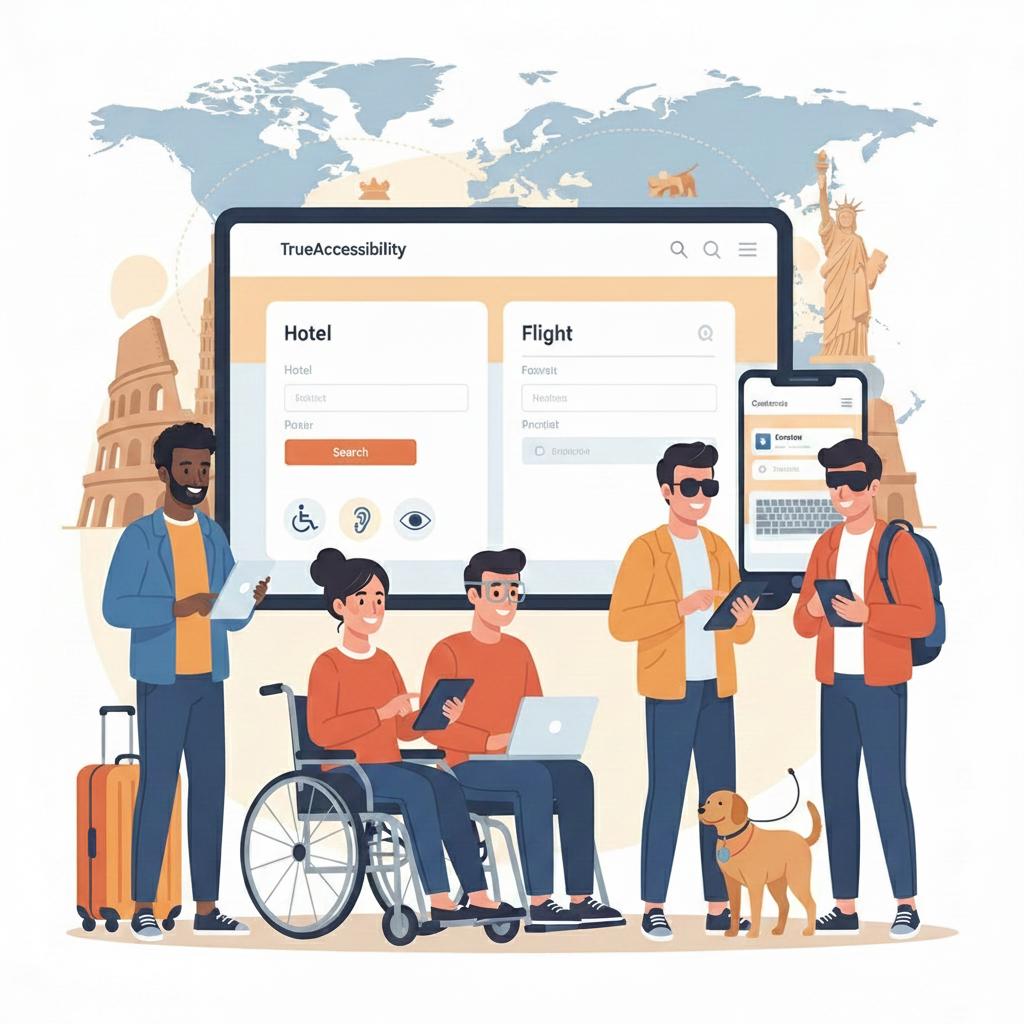
Introduction: Travel Should Begin With Access, Not Barriers
Traveling is a fundamentally human experience. It's about discovering relaxation, peace, connection and liberty. For millions across the globe, their journey gets difficult even before it starts - not at the airport, or in the hotel's lobby and not even on the web site.
Websites for travel and hospitality are the gateways to experience. If these websites are not accessible the entire experience is prevented. The booking form cannot be navigated using a keyboard, a description of a hotel dependent on only images or a search for flights that is unable to be used by screen reader users -- these are not just minor inconveniences. These are points of exclusion.
Accessibility to travel and hospitality websites is not an option anymore and is not just regarding the legal requirements. It's about trust, integrity, loyalty of customers as well as long-term growth for businesses. Inclusionary digital experiences allow travellers who have all kinds of abilities to make plans in a way that is independent, confident and respectful.
We at TrueAccessibility believe that accessibility starts with the internet. This article explains the importance of accessibility for hospitality and travel. It also reveals the actual challenges that users have to confront, the ways companies can create better experiences for their customers as well as how accessibility can transform not only compliance, but the customer experience in itself.
Understanding Accessibility in the Travel and Hospitality Context
The accessibility of digital travel experiences is about developing applications and websites which can be utilized by individuals with different abilities such as those who have hearing, visual and motor cognitive as well as neurological disabilities.
In the tourism and hospitality industry, accessibility is an added level of complexity. Customers communicate with
- The interfaces are heavily laden with search
- Calendars and date pickers
- Systems for real-time pricing and availability
- Multiple-step flow booking
- Maps, images and other location-based content
- Confirmations that are time-sensitive
Every one of these aspects should be easily accessible, not just technologically but actually.
Who Benefits From Accessible Travel Websites?
Accessibility has a greater benefit for users than most businesses are aware of:
- Blind travelers or have poor vision use screen readers
- Users who are deaf or hard of hearing relying on captions and transcriptions
- People with motor impairments navigate using a keyboard or other assistive devices
- Older travelers with impaired vision or the ability to move
- Neurodivergent users who require greater clarity and predictability
- People who have temporary impairments (injury or illness, fatigue)
- Tourists in low-bandwidth and high-glare areas
Accessibility enhances the usability of everyone. When it comes to travel, where the decisions are costly and complex the importance of clarity and simplicity is paramount.
Why Accessibility Is Critical for Travel and Hospitality Brands
Travel Is a High-Stakes Digital Experience
In contrast to casual browsing, bookings require:
- Financial commitments of significant magnitude
- Dates and times that are fixed
- Affective anticipation
- Decision fatigue and stress
If barriers to accessibility are present people don't stop and complain, they just quit. Most of the time, they do not ever.
The Business Impact of Exclusion
Inaccessible websites result in:
- Carts abandoned and bookings lost
- Costs for customer support have increased
- Brand perceptions that are negative
- Risks of compliance and legal exposure
- Insufficient loyalty from frequent travelers
In contrast, websites for travel that are accessible are able to benefit from:
- Conversion rates that are higher
- Broader market reach
- More trust in the brand
- Improved SEO and better performance
- Competitive differentiation
It is not a barrier to accessing information. can be a strategy for growth.
Common Accessibility Challenges in Travel and Hospitality Websites
Despite their good intentions, a lot of travel websites intentionally block users. Here are a few most commonly encountered obstacles.
1. Complex Navigation and Overloaded Menus
The majority of travel websites have large navigation menus that offer locations, offerings, and services as well as filters. They may include:
- Accessible only to keyboard users.
- Incorrect focal indicators
- Unexpectedly, screen readers collapse for screen readers
- Utilize hover-only interaction
If users are unable to navigate properly their way, they will experience a crash immediately.
2. Inaccessible Search and Booking Forms
Booking forms form the core of websites for travel. They are also the commonest accessibility failure.
Common problems include:
- Labels that are unclear or missing
- Date picker is not usable on keyboards
- Error messages aren't made public to screen readers.
- Timeouts that occur without notification
- CAPTCHA barriers
An inaccessible form equals a lost booking.
3. Poor Image Descriptions for Hotels and Destinations
Traveling heavily relies on visuals. But images that lack relevant alternative text do not exclude people who are blind completely.
A few examples of poor practice include:
- Alt text with a decorative design for crucial images
- Room layouts are not described or the amenities
- Use of images-only content in promotions
Images with descriptions that are accessible allow people to envision and assess their experiences on their own.
4. Maps and Location-Based Barriers
Maps can be a challenge for assistive technology.
The issues include:
- Interactive maps with no keyboard access
- The only alternative is text-based for data about location
- Instructions based solely on visual clues
For disabled travelers, it is essential to have details about their location in a variety of formats.
5. Multimedia Without Captions or Controls
videos that showcase properties or destinations are often lacking:
- Captions for deaf users
- Audio-descriptions for blind users
- Accessible playback controls
Multimedia must enhance the experience, not hinder it.
6. Cognitive Overload and Poor Content Clarity
The decision-making process for travel is complex. A lack of accessibility can cause cognitive strain via:
- Long, dense paragraphs
- Uncertain language
- Inconsistent layouts
- Unexpected interactions
Accessible content is a key factor in the clarity, predictability, as well as peace of mind in making.
Designing Accessible Travel Experiences: Key Principles
Accessibility has to be intended. Here are the fundamental guidelines that will guide your design of inclusive travel websites.
1. Start With WCAG, Design for Humans
Web Content Accessibility Guidelines (WCAG) define a standard, however accessibility isn't a check-list exercise.
The design should be focused on:
- Perceivable content
- Operable interfaces
- Understanding interactions
- A robust compatibility with assistive technologies.
If you think of people first, you will find that it is natural to follow that compliance.
2. Make Navigation Predictable and Keyboard-Friendly
Accessible travel navigation includes:
- Logical heading structures
- Clear indicator of focus
- Skip-to-content links
- Menus that can be accessed via the keyboard
It is important to know wherever they are, and also the next place they should go.
3. Build Accessible Search and Booking Flows
Bookflows must:
- Label each input field clearly
- Full keyboard navigation
- Provide real-time, accessible error feedback
- Beware of sudden timing outs
- Autofill support and correction
The ease of booking is an edge in the market.
4. Provide Rich, Meaningful Content Alternatives
Accessible content can include:
- Descriptive alt text for images
- Summaries written in text of images
- Transcripts of videos
- Descriptive descriptions of the facilities and the policies
The equality of information builds trust.
5. Design With Cognitive Accessibility in Mind
The importance of cognitive accessibility is frequently overlooked yet it is vital.
The best practices are:
- Simple language
- Clear pricing breakdowns
- The booking process is step-by-step.
- Congruent layout and usage of terms
- Refraining from excessive animations
Converting more efficiently is easier for everyone.
Accessibility and Trust in Travel Decisions
It is essential to trust when traveling. Customers must have confidence that:
- The prices are clear
- Policy is clear
- All information is true
- Help is readily available
It increases trust through the elimination of uncertainty and friction.
In the event that people with disabilities have the ability to independently conduct research, evaluate, and even book trips, businesses gain long-term loyalty, not just one transaction.
Legal and Compliance Considerations for Travel Websites
Hotels and travel businesses are operating all over the world, making accessibility compliance more important.
Key Regulations Affecting Travel Websites
- WCAG 2.1 or 2.2 3.0 3.0 - Global accessibility standard
- ADA (USA) The ADA (USA) standard applies to all websites with public access.
- EN 301 549 (EU) - Covers digital services, including travel
- UK Equality Act Requires a reasonable level of digital accessibility
- AODA (Canada) Accessibility to public services
Infractions can trigger penalties, legal action, as well as reputational damage.
The goal of compliance is to be considered a benchmark, not the ultimate goal.
Accessibility Across Different Travel Platforms
Hotel and Resort Websites
The key focus areas are:
- Accessible room descriptions
- Accessibility features that are clear (ramps and elevators)
- Engines for booking reservations that can be accessed
- Transparent policies
It is not necessary for users to contact a service to verify accessibility information.
Airline and Transportation Websites
Important elements include:
- Search for flights and seats choice
- Clear fare rules
- Accessible check-in flows
- Updates on status in real-time
The need for time-sensitive accessibility is vital for transportation.
Online Travel Agencies (OTAs)
They must also ensure that:
- Convenient accessibility across multiple providers
- Standardized content structures
- Filtering and comparison tools that can be used to access
The scale of responsibility increases.
Tourism Boards and Destination Portals
The accessibility here is comprised of:
- Guides and itineraries that are accessible, as well as the ability to download them.
- Inclusive event listings
- Transparent information about transportation
- Support for plain and multi-languages
The destination should be welcoming immediately upon clicking.
Accessibility as a Competitive Advantage in Travel
Travel brands that are forward-thinking are moving past compliance, and are incorporating accessibility in their business culture.
The benefits include:
- Customers are growing
- More the number of bookings
- Support calls are cut down
- More SEO-related visibility
- A stronger brand image
It is not a price, but can be considered an investment.
How TrueAccessibility Supports Travel and Hospitality Brands
We at TrueAccessibility We understand that travel platforms are intricate systems, not static sites.
Our approach includes:
- Audits of accessibility that are comprehensive
- Testing the flow of booking and forms
- Technology testing for assistive devices
- Review of the accessibility of content
- Monitoring and constant guidance
- Training for teams and awareness
We partner with the developers, designers, marketers and leaders to integrate accessibility in every step of the digital experience.
Measuring Accessibility Success in Travel Platforms
Success in accessibility cannot be measured only by passing audits instead, it is measured by actual outcomes:
- Abandonment rates are reduced
- The flow of bookings has been completed more efficiently.
- Positive reviews from users who have disabilities
- Improvements in SEO and performance metrics
- Fewer accessibility-related complaints
What is measured improves.
The Future of Accessible Travel Experiences
Travel in the future is digital and inclusive.
Trends that are emerging include:
- AI-powered, personalized access control using access control
- Interfaces for booking using voice
- Tours that can be accessed via virtual tour
- Help in real-time is available
- Monitoring accessibility on a continuous basis
The technology for travel is constantly evolving, and accessibility needs to change with it.
Conclusion: Inclusive Travel Begins Online
The idea of travel should be one that inspires excitement not a sense of frustration. But for too many people sites that are not accessible remain obstructions to travel.
The accessibility of travel and hotel websites goes beyond compliance. It's about respect for freedom, and opportunities. When companies design inclusively they are able to open more doors physically and digitally.
In TrueAccessibility TrueAccessibility, we are of the belief that all journeys should start with accessibility. If accessibility is a part of the digital plan, you don't only provide more users with more enjoyable experiences for all users.