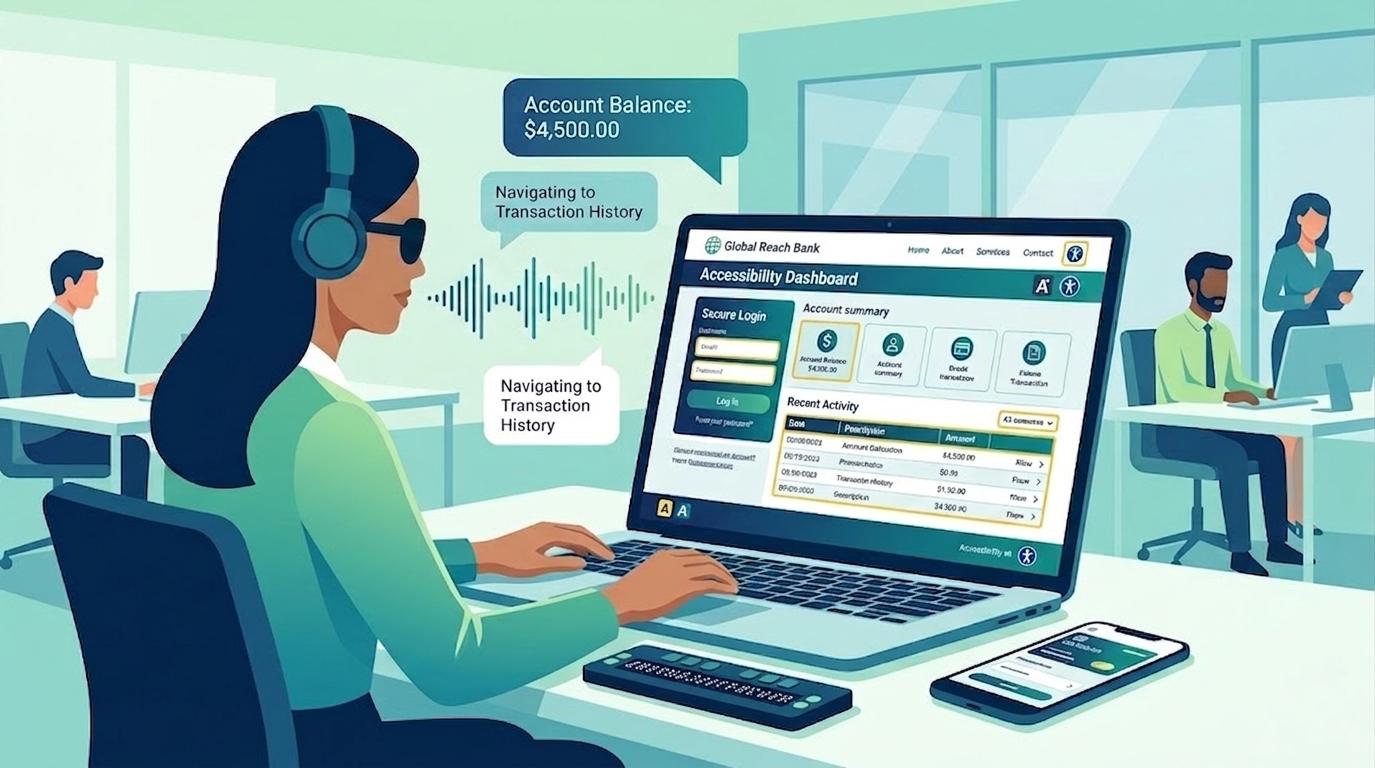
Introduction: Accessibility Testing for Financial and Banking Websites
Banking and financial websites can be found in everyday life. They are used by people to view accounts, transfer money to pay for bills, make applications to borrow money, monitor investment accounts, and use online banking services.
Since these platforms are responsible for crucial financial transactions, their accessibility is crucial.
If the banking sites aren't easy for people who are disabled may have difficulty making transactions on their own. Tests for accessibility help remove obstacles and enhance the digital experience for all customers.
Accessible banking is not just focused on the law. It improves user-friendliness, trust among customers as well as security and the general customer experience.
Why Accessibility Matters in Banking Websites
Banks must be able to accommodate people with various capabilities, equipment and methods of browsing.
The majority of users trust:
- Screen readers
- Keyboard navigation
- Voice commands
- Magnification tools
- Transcripts and captions
In the absence of proper accessibility, crucial financial services can be hard to get access.
Accessible financial websites help users:
- Verify balances on your account
- Transactions that are complete
- Complete forms
- Check out the financial statements.
- Use banking tools on your own.
Online access to digital services makes banking more convenient and reliable for all.
Common Accessibility Issues in Banking Websites
Websites for financial services often have complex designs, forms and dashboards. They also have tables as well as secure login mechanisms. In the absence of accessibility testing the features could hinder the users.
Complex Navigation Menus
Bank websites typically have areas for:
- Management of accounts
- Service of loan
- Investments
- Insurance
- Payments
A poor navigational structure could cause problems for screen readers and those who use keyboards to navigate the website in a timely manner.
Inaccessible Forms
The online banking process is heavily reliant on the form used for:
- Login page
- Registration
- Transfers of money
- Application for a loan
Accessibility issues that are common include:
- The labels are missing
- Incorrect instructions
- Poor error messages
- Keyboard traps
The problems could prevent people from finishing important financial obligations.
Poor Color Contrast
The low contrast of text may make it difficult for information to be comprehend for those with poor sight or blindness to color.
Contrast is essential to:
- Balances on accounts
- Transaction details
- Security alerts
- Notifications and buttons
Missing Alt Text
Images, icons, charts and other images must include relevant alt texts so that screen readers are able to explain visually-related content in a clear manner.
Example:
"Monthly spending chart showing higher expenses in April"
Instead of:
"Chart image"
Dynamic Content and Popups
Bank platforms typically use:
- Popups
- Notifications
- Dropdown menus
- Live updates in real time
If they are not available, screen readers could have difficulty announcing the important details correctly.
What Is Accessibility Testing for Banking Websites?
Testing for accessibility checks whether a banking or website application is usable for people who have disabilities.
Testing helps identify barriers affecting:
- Navigation
- Readability
- Form-Usability
- Keyboard interactions
- Screen compatibility with readers
Testing for accessibility helps improve usability and assists organizations to comply with the accessibility requirements, including:
- Web Content Accessibility Guidelines
- Americans with Disabilities Act
- Disabilities Act ADA compliance requirements
Key Areas to Test in Financial Websites
Websites that are financial require thorough accessibility testing since users rely on them to perform important everyday routines.
Screen Reader Compatibility
Screen readers are used to test screen readings and help make sure visually impaired individuals have the ability to:
- Information about accessing your account
- Know the financial details
- Use menus to navigate
- Transactions that are complete
Tests should confirm:
- Proper heading structure
- Descriptive labels
- Logical reading sequence
- Link and button accessibility
Keyboard Accessibility
The majority of users visit websites with just the keyboard.
Tests for accessibility must confirm that the following:
- You can access all menus
- Forms are used to navigate
- Transmit transactions
- Close popups
- You can navigate without keyboard traps
Indicators of focus are crucial.
Form Accessibility
Formulations should be easy as well as clear and simple to navigate.
The testing should be able to evaluate:
- Labels for forms
- Instructions
- Error messages
- Field focus orders
- Accessible CAPTCHA alternative
Forms that are accessible improve the users' experience and decrease confusion.
Accessible Tables and Financial Data
Banking websites often display:
- Statements of account
- Transaction history
- Financial reports
- Tables of investments
Tables need to be designed correctly to ensure that screen readers accurately identify columns and rows.
Color Contrast and Readability
Testing for accessibility should ensure that
- Text can be read
- Alerts are clearly visible
- Buttons are clearly visible
- The ability to comprehend graphs and charts is a given.
The clear interface is more user-friendly to all users.
Mobile Accessibility
A lot of customers use financial services via mobile devices.
Testing for mobile accessibility should contain:
- Responsive layouts
- Text sizes that are readable
- Touch-sensitive targets that can be accessed
- Screen reader compatibility
- Simple navigation
Mobile banking on the go increases convenience as well as customer satisfaction.
Security Features and Accessibility
Websites for banking often have sophisticated security measures, including:
- Multi-factor authentication
- CAPTCHA Systems
- Timeout alerts for sessions
They should be available without causing obstacles.
Example:
- CAPTCHA should also include options for audio
- Timeout alerts are designed to work in conjunction when combined with screen readers.
- The authentication should be compatible with typing
Accessibility and security should be working together to ensure a safe and accessible digital experience.
Benefits of Accessibility Testing for Financial Institutions
Improvements in accessibility benefit business and users.
Better Customer Experience
The accessibility of banking sites helps users to complete their tasks with ease and confidence.
It improves:
- Customer satisfaction
- Engagement
- Trust
Wider Audience Reach
Financial accessibility services are available to more people, especially older adults as well as people with disabilities.
Improved Brand Reputation
Digital experiences that are inclusive show the professionalism of our staff and provide excellent customer service.
Businesses that emphasize accessibility frequently create stronger loyalty among customers.
Better Compliance Support
Accessibility testing can help organizations get in line with
- Web Content Accessibility Guidelines
- Americans with Disabilities Act ADA conditions
- Standards for digital accessibility
Reduced Usability Issues
Testing can help identify accessibility issues prior to they affect business processes or users.
Automated and Manual Accessibility Testing
Both manual and automated tests are crucial for websites that deal with financial transactions.
Automated Testing Helps Detect:
- The alt text is missing
- Contrast-related problems
- Link empty
- The labels are missing
Manual Testing Helps Evaluate:
- Usability of screen readers
- Keyboard navigation
- Formal interaction
- Real user experience
- The accessibility of financial workflows
Combining these two methods produces the most reliable accessibility test outcomes.
Common Accessibility Mistakes in Banking Websites
A few common accessibility issues include:
- Incorrectly labeled forms
- Inaccessible login systems
- Text with low contrast
- Navigating complex
- The screen reader is not displaying the correct announcements.
- Inaccessible PDF statements
- Keyboard problems with navigation
Resolving accessibility issues significantly increases usability and the customer experience.
Accessibility and User Trust in Banking
The importance of trust is paramount when it comes to the world of financial services. Banking platforms are expected to be safe, secure and user-friendly.
Inaccessible websites can lead to discontent and decrease customer trust.
Accessible design helps create:
- Improved customer relations
- Simpler interactions
- More dependable digital experiences
Final Thoughts
Tests for accessibility are essential to banks and financial websites since customers rely on these websites to perform their daily activities.
The accessibility of banking means that everyone has the ability to manage their finances, finish transactions, and get data on their own and with ease.
In order to improve the screen reader's compatibility with keyboard accessibility, screen usability, color contrast as well as mobile accessibility Financial institutions are able to create better digital experiences for all.
Accessibility doesn't just concern complying in accordance with Americans with Disabilities Act or Web Content Accessibility Guidelines. It's about creating secure, comfortable, accessible and user-friendly bank experiences for each customer.