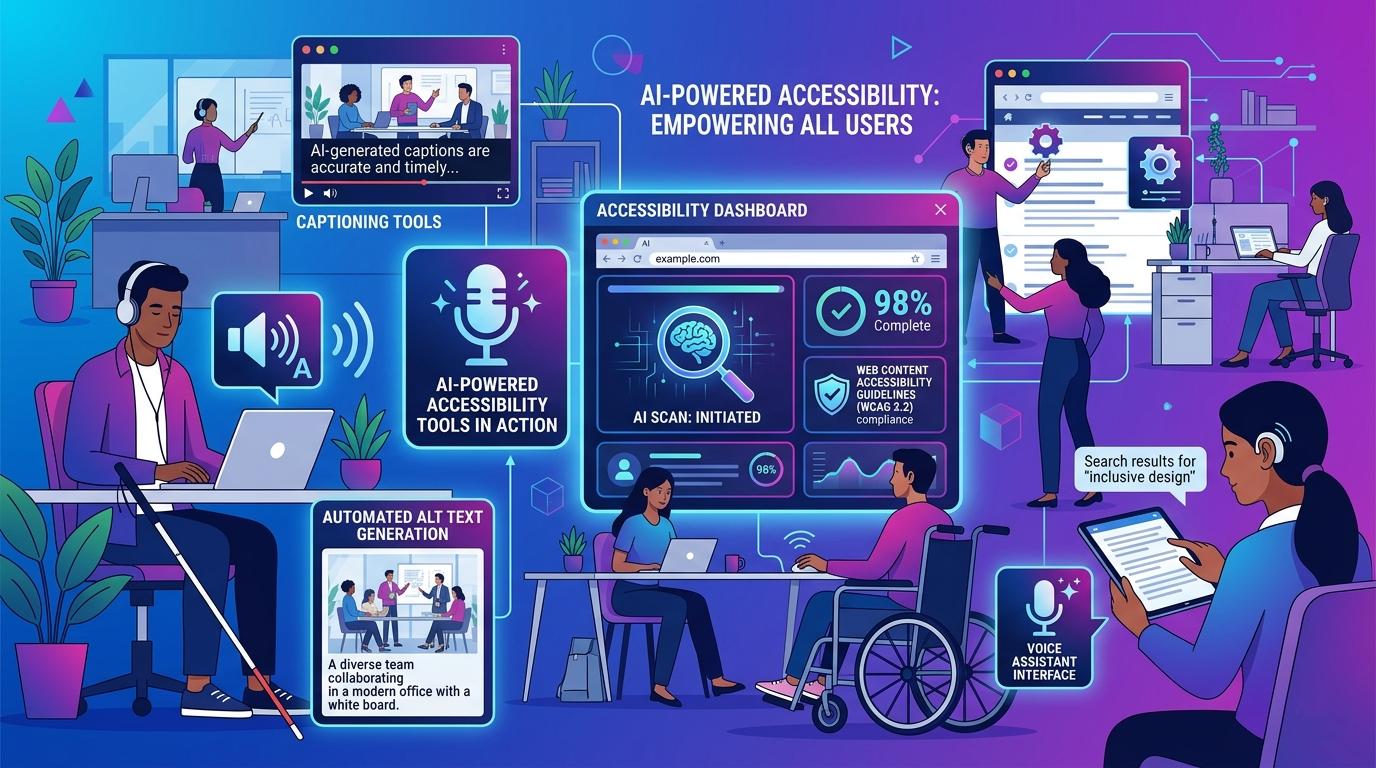
Introduction : AI Accessibility Tools Every Business Should Know About
Artificial intelligence is changing methods businesses design and create digital experiences. From chatbots that assist customers to automated content creation, AI is now an integral part of all modern workflows. One of the areas in which AI has a significant effect is accessibility.
Companies are using AI-powered accessibility tools that improve web accessibility, find accessibility issues, produce captions, write alt texts as well as assist users disabled more efficiently. The tools allow organizations to develop more accessible digital experience while also increasing efficiency and reducing time.
While AI can't replace the human expertise in accessibility however, it is a significant aid to accessibility when employed correctly.
Why Accessibility Matters for Businesses
Accessibility guarantees that sites, apps, websites, and other digital platforms are accessible to anyone, even those handicapped.
It is possible to rely on
- Screen readers
- Voice navigation
- Keyboard controls
- Transcripts and captions
- Magnification tools
If accessibility is not supported the users might have difficulties:
- Read and digest the information
- Explore to websites
- Forms that are complete
- Watch videos
- Access essential services
Making digital experiences accessible improves accessibility for everyone and also helps companies expand their reach to a larger number of customers.
How AI Is Transforming Accessibility
Traditional accessibility improvement often requires manual testing, updating content as well as technical development. AI tools can simplify some of these steps and can make accessibility management easier and more adaptable.
AI accessibility tools can assist in:
- Accessibility scan
- Caption generation
- Alt Text suggestions
- Voice assistance
- Text-to-speech
- Real-time transcription
- Improved readability
The technology helps businesses with providing more online-friendly experiences.
AI Accessibility Tools Businesses Should Know About
A variety of AI-powered tools are accessible to help businesses improve access to websites, apps as well as documents and media content.
Automated Accessibility Testing Tools
AI-powered accessibility scanners can help you identify frequent accessibility issues that can be found on web pages.
The tools are able to detect problems that could be causing problems, such as:
- The alt text is missing
- Lackluster color contrast
- Buttons that are empty
- Labels for forms that are missing
- Improper heading structure
Automated testing tools can help companies quickly spot barriers to accessibility when developing and maintaining.
AI Captioning and Transcription Tools
Transcripts and captions make it easier for those deaf or hard of hearing.
AI-powered devices can create:
- Video captions
- Transcripts of meetings
- Audio subtitles
- Real-time transcription of speech
It improves accessibility to:
- Video content
- Online meetings
- Webinars
- Platforms for education
The automated transcription tool also increases access to content as well as usability.
AI Alt Text Generators
AI Image Recognition technology is able to create alt text suggestions from pictures.
The tools analyse images and generate descriptions, such as:
- "Woman working on a laptop in an office"
- "Person using a wheelchair in a conference room"
AI-generated alt texts can enhance accessibility of images, specifically on websites that have large media collections.
Human review is vital to ensure the accuracy and quality of descriptions.
AI-Powered Screen Readers and Voice Assistants
Modern AI technology is enhancing user experience for screen readers as well as voice-based interaction.
AI-powered voice tools are able to assist users in the following ways:
- Use the navigation menu to navigate to websites
- Read digital content aloud
- Interface with apps
- Complete tasks using voice commands
The tools increase accessibility for the users using:
- Visual impairments
- The limitations of mobility
- Reading difficulties
AI Readability and Content Simplification Tools
Certain AI tools simplify difficult information and enhance readability.
They can be used to:
- Condense complex sentences
- Improve grammar clarity
- It is suggested to use a more simple formulation
- Organise the structure of content
It assists users in:
- Cognitive disabilities
- Learning difficulties
- Language barriers
Communication that is clear and concise improves accessibility for everyone.
AI Translation and Multilingual Accessibility Tools
AI software for translation helps businesses produce multilingual, accessible content for worldwide viewers.
They can be used to:
- Translate websites
- Create subtitles for multiple languages.
- Improve multilingual communication
Multilingual accessibility allows for greater audiences and greater accessibility.
AI-Based Accessibility Monitoring Platforms
A few platforms constantly monitor websites for accessibility issues, providing automatic reports.
They can assist organizations in:
- Performance of the track's accessibility
- Detect the latest problems
- Track progress in ensuring compliance
- Keep standards of accessibility in place over time
Continuous monitoring can help businesses control access more efficiently.
Benefits of AI Accessibility Tools
AI-powered accessibility tools offer a variety of advantages to businesses.
Faster Accessibility Improvements
AI tools help to detect accessibility issues quicker than manual inspection by itself.
Teams can benefit from this:
- Time is money.
- Improve efficiency
- Increase accessibility efforts
Better Content Accessibility
Automated captions and alt text and improvements in readability in making digital content more accessible and easier to comprehend.
Improved User Experience
Improved accessibility can create a more enjoyable experience for everyone including those handicapped.
Supports Accessibility Compliance
AI tools can assist organizations find issues that relate to:
- WCAG guidelines
- ADA accessibility standards
- Standards for digital accessibility
But, AI should support compliance actions, rather than replacing expert assessment.
Limitations of AI Accessibility Tools
Although AI accessibility tools are useful, they're not ideal.
AI might struggle with:
- Understanding context
- Evaluating user experience
- Detection of complex usability problems
- Writing meaningful alt text
- Analyzing logical navigation
Example:
AI could recognize images that contain a person however it may not be able to comprehend its purpose in the web page's content.
That's why manual accessibility testing as well as the review of a human are vital.
Why Human Accessibility Expertise Still Matters
Accessibility concerns real-life user experiences, not technological validation.
Human accessibility experts can more effectively determine:
- Usability of screen readers
- Keyboard navigation
- User interaction
- Clarity of content
- Workflows for accessibility
The most efficient accessibility plan combines:
- AI automation
- Testing by hand
- Human accessibility experts
Together, they can create better and more efficient improvements in accessibility.
How Businesses Can Start Using AI Accessibility Tools
Business owners can improve accessibility through the integration of AI tools to their workflows.
Use Automated Accessibility Scanners
Regular accessibility scans help identify common issues quickly.
Add AI Captioning for Multimedia
Webinars, videos, as well as training materials must contain captions as well as transcripts.
Review AI-Generated Alt Text
AI suggestions must be vetted for accuracy and the context.
Combine Automation With Manual Testing
AI tools are most effective when they're combined with real accessibility testing as well as user evaluation.
Train Teams on Accessibility
The awareness of accessibility across development, design and content teams can lead to more long-term benefits.
Accessibility and the Future of AI
AI technology continues to develop rapidly, while accessibility tools are getting increasingly sophisticated every year.
The next generation of AI accessibility improvements could enhance:
- Support in real time
- Accessibility experiences that are personalized
- Smarter screen reader supports
- A more precise interpretation of the content
- Flexible interfaces
With the expectations for digital accessibility growing, AI will likely play more of a role making sure that businesses can create accessible experiences.
Final Thoughts
AI accessibility tools help firms improve accessibility to digital content quicker than ever. From automated accessibility testing to caption generation using AI to AI-powered alt texts and voice aid, these apps aid in accessibility improvements across web sites as well as digital platforms.
But, AI should be viewed as a supporting system, instead of a full substitute for human accessibility skills. The combination of AI-powered automation and the manual process of testing and real-time usability assessment yields the most effective outcomes.
Accessibility is all about ensuring that everyone has to be able to access, comprehend, and use digital resources easily and without difficulty.
Companies investing in accessibility are today developing more user-friendly, inclusive and future-proof digital experiences for all.